
Discovering Southern Oregon – August 2026
THERE ARE FEW PLACES in Southern Oregon where you can truly grasp the scale and beauty of the land quite like standing on the launch site at Woodrat Mountain.
Perched high above the Applegate Valley near Ruch, Woodrat is a place where the earth seems to fall away and the sky takes over. From the edge of the launch, the landscape unfolds in every direction—vineyards, ranches, oak-studded hillsides, and winding country roads stitched together across the valley floor. Beyond it all, the Siskiyou Mountains roll westward into rugged, untamed backcountry. To the east, the Rogue Valley opens wide, stretching toward the distant, snowcapped peaks of the Cascades.
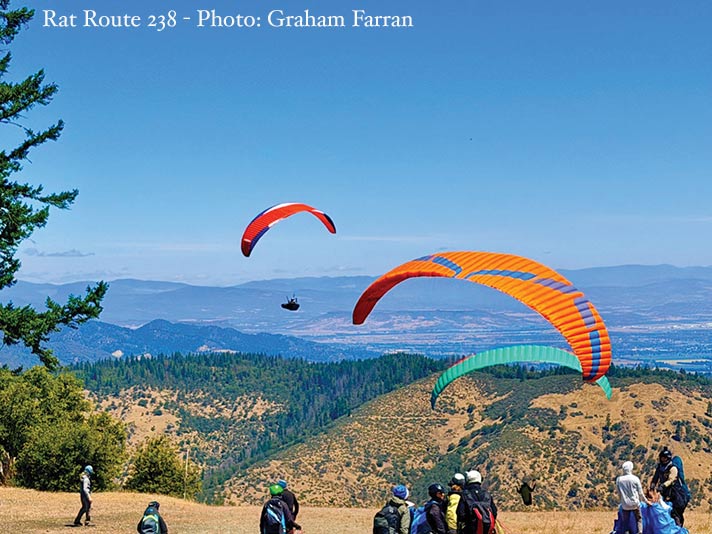
On a warm Southern Oregon afternoon, I joined a group of paragliders gathered at the top of Woodrat Mountain. The atmosphere was calm but focused, the kind of quiet anticipation that comes before something extraordinary. A tandem pilot nearby offers a simple reassurance to a first-time flyer: “You’re not running off the mountain—you’re being lifted off. Just trust it.”
Above us, the sky is already alive. Bright wings of orange, blue, red, and yellow drift silently overhead. One by one, pilots launch and begin to climb, circling effortlessly in invisible currents of rising air. From the ground, they look almost unreal, suspended between earth and sky, moving with a quiet defiance of gravity. Hawks and turkey vultures share the same space, riding the same thermals, turning in patient spirals as if the entire sky is in slow motion.
Woodrat Mountain has become one of the most respected paragliding sites in the western United States. Pilots travel from across Oregon, California, Washington, and beyond to experience its consistent thermals, long ridge lines, and proven cross-country potential. On the right day, skilled flyers can launch from Woodrat and travel dozens of miles, sustained entirely by mountain lift and thermal energy
The main launch sits roughly 3,800 feet above sea level. Pilots arrive carrying carefully packed gliders, plus a harness, a helmet, and a radio. Before takeoff, there is no rushing. Instead, there is observation and patience—reading the wind, watching clouds develop, feeling subtle shifts in temperature, and studying the foliage below for signs of rising air moving up the mountainside.
Southern Oregon’s summer heat plays a critical role. As the sun warms the dry slopes and open meadows, “thermals” begin to form—columns of rising air that become the invisible elevators to the sky: and often terminate at the base of flat-bottomed clouds. Pilots watch for these kinds of clouds to line up in “cloud streets” which can transport them to distant destinations. At Woodrat, the pilots know where the triggers are located for reliable thermals near launch.
Experienced pilots often watch the birds for guidance. When turkey vultures, hawks, or eagles begin circling tightly and climbing, it signals a thermal strong enough to hold. Pilots follow their lead, entering the same invisible column of air, spiraling upward until the valley drops away beneath them.
The launch itself is deceptively simple. A pilot waits for a breeze to come up the slope and then inflates the wing, by pulling tension on the lines connected to the leading edge of the glider. It surges overhead, and the pilot then runs downhill—three steps, five steps—until the lift generated by the airflow over the wing overcomes the force of gravity and the pilot is suddenly in flight. In that moment, everything shifts from effort to trust.
As the day progresses into evening, Woodrat sometimes offers one of its most magical experiences: the “glass-off.” This occurs when the sharper, more turbulent daytime thermals fade into softer, smoother conditions. Lift is abundant and the ride is gentle. Pilots remain aloft in golden light, drifting quietly above the valley as shadows lengthen and the landscape softens below.
To local pilots, flying Woodrat is far more than recreation. It is community. It is ritual. It is freedom. At the center of this flying culture is the Rogue Valley Hang Gliding & Paragliding Association (RVHPA rvhpa.org), known locally as simply, “the flying club.” This volunteer-driven organization, formed in 1977, a year before the first hang glider launched from Woodrat Mountain, plays a vital role in maintaining launch and landing zones, monitoring weather conditions, promoting safety, and mentoring new pilots entering the sport. It is as much a stewardship group as it is a flying community.
The RVHPA also hosts the annual “Rat Route” fly-in, drawing pilots from across the West Coast. It combines cross-country flying challenges with flight educational and safety lectures, flight briefings, and dinner gatherings with live music at local wineries in the Applegate Valley. This year’s event also featured a comedy show, classical music performances, and an alphorn ceremony.
During these events, it is not uncommon to see over a hundred wings filling the sky. Pilots climb to altitudes upwards of 10,000 feet, and attempt long-distance flights that test skill, patience, and understanding of the air. The current Woodrat distance record approaches nearly 100 miles.
For those on the ground, the experience is just as memorable. Locals and visitors gather along the river, at vineyards, and on hilltops, watching colorful wings drift silently overhead like moving brushstrokes across the sky.
Ask almost any Southern Oregon pilot what draws them back, and the answer is rarely just about flying. Woodrat is addictive not only because of its world-class conditions, but because of the feeling it creates—of being part of something larger than yourself.
There is something deeply grounding about flying above the Applegate Valley, circling with birds, and eventually landing alongside friends who share the same understanding of what it means to trust the sky.
It is a rare place where world-class flying, small-town community, and the wild beauty of Southern Oregon all meet in a single, unforgettable experience.