
The Unfettered Critic – September 2026
EXCURSIONS to our local Motion Picture Palace have, for us, become much less alluring these days. There’s nothing wrong with the venue per se (although our increasingly vintage bodies prefer the comfy home sofa and the boob-tube). But if we’re being honest about it, a pair of human beings can endure only so much…disappointment.
Despite the promise of the Palace’s “luxury lounger” seats, we need a compelling reason (such as an impending Jville Review deadline) to draw us into a popcorn-scented auditorium. Recently we were lured to Steven Spielberg’s Disclosure Day (which didn’t disclose nearly enough plot to support its length), and we tolerated the redundant series of wham-bang-super-fights aimed at stretching Supergirl into being able to define itself as “feature-length.” But neither evoked within us a response strong enough to support composing a column.
But at last came the arrival of the cinematic phenomenon that EVERYBODY was talking about. The one that pulled in an astounding number of “reserved” ticket sales even before it hit the screens. We figured that this would be it—the one that at last has scaled the heights of worthiness that we were looking for: 172 minutes of epic ancient Greek mythology! And we weren’t alone; all of the Hollywood bankrollers were wondering if a 3000-year-old tale could possibly cover the expended production and marketing costs of $375 million; and increasingly vulnerable industry execs were sitting on pins and needles—until the public salvaged their careers with a billion-dollar Band-Aid! Yup, director Christopher Nolan had done it—and The Odyssey became an instant billion-buck hit.
But as you may have heard (or even hummed along), we’re of the mind that “money can’t buy us love.” It’s quality of art and craft that prove a production’s worth, and we didn’t care when the money became the movie’s big headline. Until another number caught our attention.
Nolan developed his screenplay for The Odyssey from a highly regarded translation of Homer’s epic by Emily Wilson, a professor of classical studies at the University of Pennsylvania. Her publisher had expected the work to sell perhaps a few thousand copies, which would have been good for such a scholarly tome—yet as word about the movie spread, sales of Wilson’s printed work reached one-million!
And how did Wilson respond? Well, rather than add Nolan to her Christmas card list, she wrote a vitriolic piece about it for the London Review of Books, and a second for The Atlantic, in which she called Nolan’s movie “emotionally empty” and “uncomplicated.”
Isn’t there some sort of expression about not looking a gift horse in the mouth? Even if it’s a Trojan one?
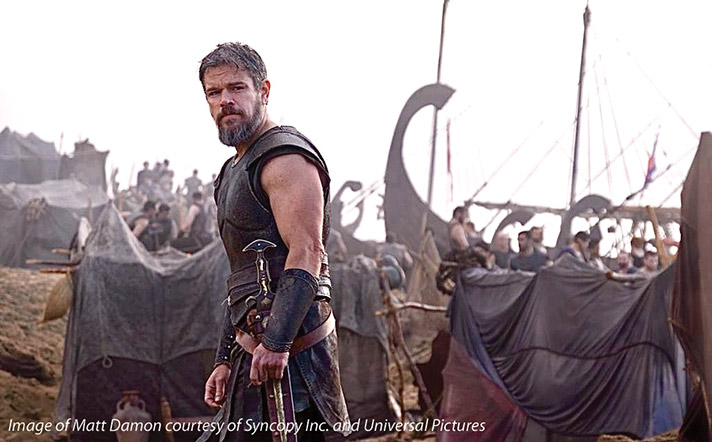
So inspired by that scholarly argument, we went, we saw, and we gotta admit that we can’t disagree with Wilson. Sure, the characters go through the motions, but they just don’t emit emotions. Anne Hathaway’s portrayal of Odysseus’s long-abandoned wife Penelope scratches at the surface of her, and our, feelings, as does Elliot Page as the loyal Sinon in his few minutes onscreen. But no character exhibits a strong drive, a passion—especially not Matt Damon’s Odysseus, who looks properly pensive and sad…but is that really enough? The highly publicized actors—like Zendaya (Athena), Lupita Nyong’o (Helen of Troy), and Charlize Theron (Calypso)—come and go, but they don’t get properly introduced to the audience, so they make little impression.
The world that Odysseus circles to reach home is round, but the one that Nolan put on film just lays flat. Honestly, the only character we felt any sentiment for was the Cyclops.
His plight will break your heart.
 Paula and Terry identify as writers, with an ever-increasing number of published works to support the supposition. They live a primarily pastoral life in the enchanted town of Jacksonville.
Leave A Comment