
The Unfettered Critic – June 2025
YOU, DEAR READER, have little reason to concern yourselves with the whims that flutter aimlessly through your Unfettered Critics’ brains at those rare moments when they’re not engrossed in pictures moving across a screen, big or small. Nevertheless, we’re audaciously going to pretend that you are interested, and invite you on a brief non-cinematic journey.
Consider, if you will, the dictum: size matters.
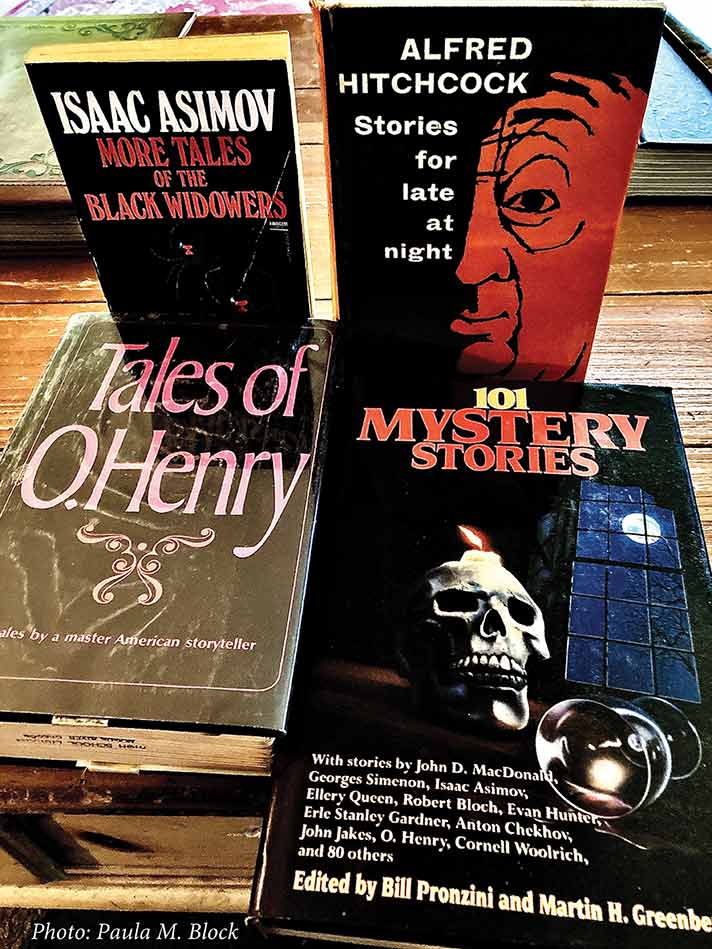
A short story, for example, is compressed. Every word carries weight. With a novel, an author has opportunity to describe a setting, a situation, a character’s motivation. If the novelist needs a character to stop and smell the roses, he/she can describe the joy of sauntering into a garden, reminiscing about the origins of a favorite Rosaceae, be dismayed by the sudden prick of a thorn, and finally, inhaling the heady fragrance. The author’s freedom to wander provides the character (and page count) equal freedom.
Short story writers have no such freedom. Their format must be compact, compressed, direct. Wanna smell a rose? There’s one in a vase on the mantle next to the gun. Quick. Concise. Unexpected.
Truly great short stories tend to remain with you, like worms nibbling at your brain. Think of “The Tell-Tale Heart” by Edgar Allen Poe; “The Gift of the Magi” by O. Henry; “An Occurrence at Owl Creek Bridge,” by Ambrose Bierce. Once you’ve read the dozen or so pages of each, their impact becomes imbedded. On the other hand, do you remember all 850-plus pages of Larry McMurtry’s Pulitzer Prize-winning novel “Lonesome Dove”? (It was about a cattle drive, right?)
Other brain-nibblers that remain with us:
“Silent Snow, Secret Snow,” by Conrad Aiken. A 12-year-old boy finds himself growing more and more distanced from his family and day-to-day life, and more and more engrossed in a macabre fantasy that his world gradually is being covered by snow, burying all the annoying intrusions of reality.
“Of Missing Persons,” by Jack Finney. Ever wish that you could be anywhere but your boring, humdrum life? “I’m a young guy who works in a bank. I don’t like the job…and I never will,” says the protagonist. Then he meets a stranger who tells him about a travel agency that will sell him a one-way ticket—good for one day only—to a very special place…
Then, of course, there’s Shirley Jackson’s “The Lottery,” perhaps the most chilling 3,778 words ever published. You will love it with every scrap of “Glad it wasn’t me!” that you didn’t know you could muster. This is classic literature, taught at university level not as a sample of a short story, but a sample of classic literature.
All of these stories, by the way, can be accessed online. Just Google the title, find a PDF, and get set to attain a free and forever memory. You’re welcome.
Recently we’ve discovered the short stories of author Amor Towles, who you may recall from his novel “A Gentleman in Moscow.” Towles’ 2024 collection, “Table for Two,” includes “The Bootlegger,” a story about possible repercussions of judging others. It’s painfully relatable—too relatable—to be ignored.
Closer to home, there’s “My Year at the Good Bean,” by EA Luetkemeyer, or Gene, as his Jacksonville friends call him when they meet up at, yes, the Good Bean. His tales are, without question, unique. If titles like “The Body that Fell From the Sky,” and “Becoming Nobody” remind you of favorite Twilight Zone episodes, you’ll want to follow Gene into that other dimension.
“My Year at the Good Bean” and “Table for Two” are available at Rebel Heart Books, conveniently located just around the corner from that coffee shop.
That’s our (short) story—and we’re sticking to it.
 Paula and Terry identify as writers, with an ever-increasing number of published works to support the supposition. They live a primarily pastoral life in the enchanted town of Jacksonville.