
Jacksonville Review – November 2025
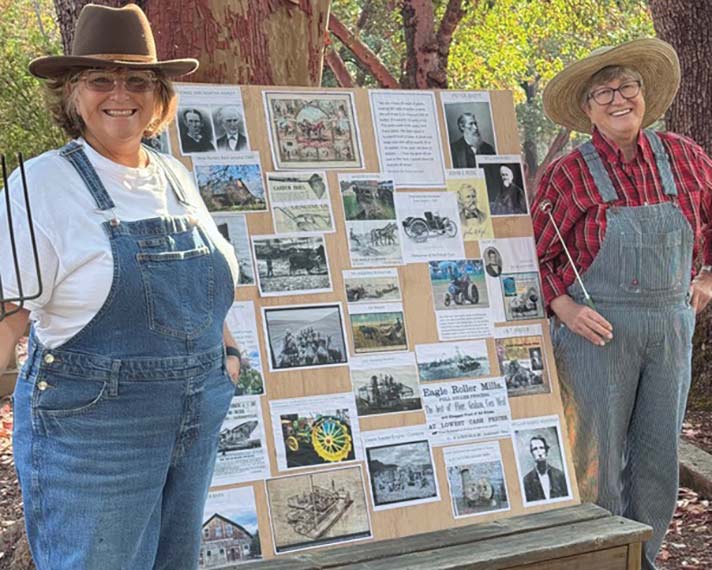
HISTORY SATURDAY in the Cemetery concluded in September with another excellent and enthusiastic talk by Pam and Teresa Smith entitled “Early Farmers and Ranchers in the Rogue Valley.” The “Smith Sisters” (no relation) looked the part in farm overalls and Fedora and straw hats (with pitchforks at the ready) as they explained methods of harvesting and demonstrated early tools of farming and ranching. They illustrated their presentation with a large display board of historical photographs showing several of the valley’s crop-growing and stock-raising pioneers, as well as life on their 1800s-era farms and ranches.
We learned that the doctrine of Manifest Destiny and the 1850 Donation Land Claim Act spurred the westward migration that brought settlers looking for new beginnings where, as early farmer Isaac Constant put it: “a man can make a living… with half the labor he can in the States.” Getting here, though, with everything needed to be successful (family, provisions, animals, tools, seed, etc.) was the first challenge. Then over the years, as these early wheat-growing subsistence farmers and stock raisers acquired additional land and more productive tools and equipment (e.g., threshers and steam traction engines), their efforts were able to feed the subsequent waves of gold miners and others who populated early towns like Table Rock City (now Jacksonville).
Pam and Teresa profiled early farmers and ranchers, both in their talk and on the tour that followed, including Robert Vinton Beall, the one-time largest wheat grower in the valley; stock raiser William Bybee, said to have owned over his lifetime nearly half of Jackson County; Hugh Barron, a cattle and sheep rancher who was once the county’s “heaviest taxpayer;” the Wendt family, who added dairy farming (along today’s 5th Street) to the wheat and livestock culture; and Peter Britt, the father of southern Oregon’s fruit industry, including pears and grapes. Thanks to Pam and Teresa for sharing a wealth of interesting information in such an engaging manner!
The following Saturday saw a record turn-out for our last Marker Cleaning Workshop of the season, co-organized by board member Dee Reynar and volunteer Jack (Butch) Frost who will be leading the marker cleaning activity in the future. The nineteen members of September’s crew included several new folks, all of whom got personal instruction in safe methods for cleaning cemetery markers to make them readable again. Together the group cleaned a total of thirty-six headstones, markers and monuments (nearly one-hundred fifty for the season), accomplishing Dee’s goal of dramatically improving the appearance of the fixtures inside the roadway around the Sexton’s Tool House. Mission accomplished! Thanks to all for a job very well done!
Flags for Our Veterans – Retrieval Thursday, November 13, 10-11am—Flags placed previously at the gravesites of our Veterans will be retrieved for repair and storage. Meet at the Sexton’s Tool House, top of Cemetery Road, to help. Parking within the cemetery.
Please check our website at friendsjvillecemetery.org for future events and programs.
Featured image: Teresa Smith and Pam Smith, History Saturday, September 2025. Photo: Eric Rogers, FOJHC