
Trail Talk – May 2026
LATE SPRING finds trails in prime condition for some welcome time in the woods. Our disappointing winter season left little residual snow, so high country trails will be accessible much earlier than normal. We can even expect mosquitoes will be out and about early, and in great numbers, before hot summer days turn cool, damp trail surfaces into bulldust and loose gravel.
Local “valley” paths are enjoying a healthy bloom of spring flowers, but alas, they arrived early and will depart early, as well. Hillsides of popcorn flowers, like snow drifts, were quite prominent by late March, not willing to wait until their normal arrival in April. Sea blush punctuated the drifts with their subtle pinks. Trilliums bloomed before the equinox, impatient as well. Soon, the astute hiker will enjoy the fragrance of mock orange blossoms, whose gentle, wafting scent soon gives over to the sometimes-intoxicating perfume of Washington, aka Shasta, lilies. Those popcorn and blush hillsides soon give way to poorly named tarweed, whose brilliant yellows foretell the hotter days of summer.
The normal chuckle of canyon bottom streams is muted this year. Perhaps the water runs quietly to not proclaim its presence, hoping to remain hidden from the too soon arrival of hot, dry summer days. Its whisper is always welcome as we make our way to where our footsteps carry us; its absent voice a void in our conscious world as we wend through the wilds.
Poison oak, adorned so brilliantly in its early spring radiance of crimson, gold, and tangerine, has transformed into hues of green. The flowering abundance attracts pollinators of all shapes and sizes, and leads one to wonder about the qualities of its nectar and the properties of poison oak blossom honey. Madrone blossoms attract delightful buzzing honeybees, and soon these orange barked trees, so common to our forests, will turn darker red and begin losing the outer bark as well as last year’s leaves.
Birdsong fills the air in our local forests. Orange-crowned warblers, freshly returned from a winter in the south, flit and chatter in the oak savannah, outdone in song only by the yellow-breasted chat. Forested canyons echo with Pacific wren’s song and raucous calls of Pileated woodpeckers, while noisy jays seem ubiquitous in any location. Locating a convenient bench along our woodland trails, we “nature bathe” and take in these sounds and smells, content in comfortable surroundings.
As we renew our acquaintance with local trails, it’s an appropriate time to review our trail etiquette. The work that our maintenance crews have diligently pursued during the colder winter months is to be enjoyed and respected. Switchbacks and lazy “S” turns are designed to lessen grades and to prevent trail erosion. Cutting corners is poor trail manners, and counterproductive to getting out for a walk, run, or bike ride—why consider you’ve walked a certain distance when you’ve shortened the trip with “cow-pathing?” Other simple rules of etiquette: travel in the center of the trail, yield to uphill traffic, wheels yield to heels… Enjoy your outing; the trails are there for you.
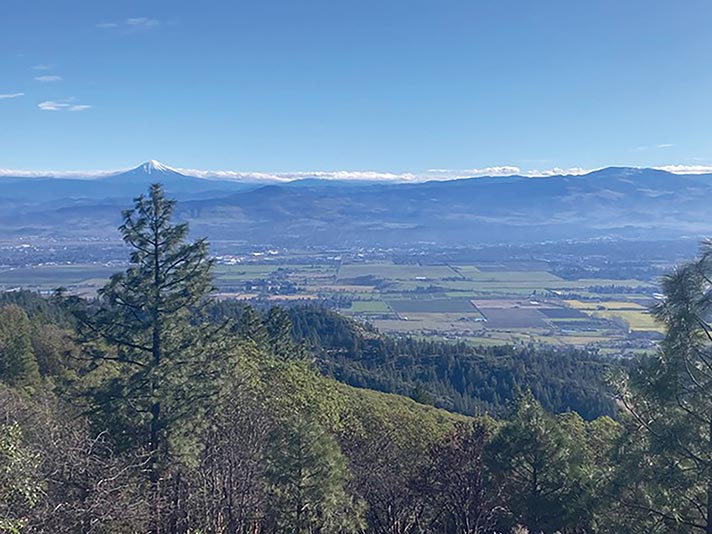
Featured image: Valley view from Forest Park Bear Ridge Trail. Photo: Clayton Gillette
 Trail Talk is a monthly column by Clayton Gillette about hiking the Jacksonville Woodlands trail system. For more information, please visit the Jacksonville Woodlands Association website at