
Jacksonville Review – November 2026
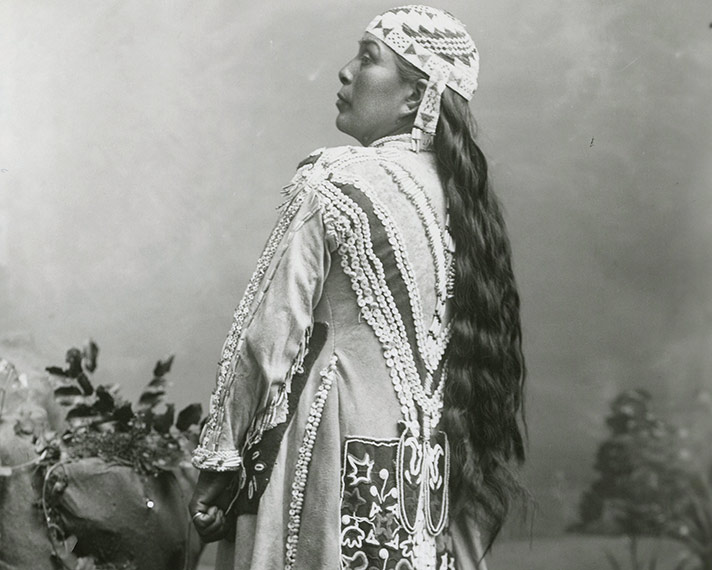
THE FRIENDS of Jacksonville’s Historic Cemetery (FOJHC) concluded this year’s History Saturday in the Cemetery season in September with a look-back to the time it all began and a talk on “Native Americans—the Rogue Valley’s First Residents.” Presented by Friends board member and History Saturday program coordinator, Ellen Martin, and Friends docent, Mike Wilson, the talk dealt with a difficult subject informatively and with the respect due both the ultimately displaced Native Americans and the incoming settlers who found it increasingly difficult to resolve their differences.
Ellen and Mike began by reminding us that, according to Bureau of Land Management estimates, people have inhabited the Rogue Valley for some 15,000 years, and that prior to the discovery of gold in Jacksonville in 1851, Takelma tribes were living along the Rogue River and in the nearby uplands (Latgawa), with several other bands of Indians also in the area (e.g. Shasta, Tututni). They followed the seasons, living in winter and summer villages, and spent the spring, summer, and fall collecting food for winter. Acorns and camas root were storable staples, while fish were the main animal source of food, along with deer, elk, and many smaller animals.
The Takelma were highly-skilled craftspeople, making needed tools (mortars and pestles for grinding, knives, and axes, for example), watertight baskets for food storage, and awls, sinew thread, and bone needles to help turn deerskin into clothing. Fire was a Takelma way of life and was used to keep the oak woodlands healthy, improve grazing, and remove brush thereby reducing the risk and impact of wildfire. Like today, land stewardship was essential to survival.
While Native American contacts with Euro-American explorers and fur trappers (early 1700s) were respectful, legislation such as the Northwest Ordinance (1787) and Donation Land Claim Act (1850) encouraged westward expansion and, along with the gold discovery, brought large numbers of settlers to the area whose farms and orchards replaced some 2.5 million acres of the meadows Native Americans had long called home. The result was competition for land, food, and resources which in time brought violence culminating in the Rogue River Indian Wars of the 1850s. After heavy losses on both sides, remaining Native Americans were removed to the Coast Indian Reservation.
Despite its characterization as “one of the most rapid, violent endings of a native population anywhere in this country,” the Takelma culture endured and has recently seen some return of land along the Rogue River and a continuation of native customs such as the Salmon Ceremony. As noted at the outset, this was a difficult chapter in the history of the Rogue Valley but, as Ellen and Mike point out, “we can’t forget those who came before us.” Thanks to Ellen and Mike for a very interesting talk and tour and to Ellen for producing a memorable season of History Saturday!
Flags for Our Veterans – Retrieval, Thursday, November 12, 10-11am—Flags placed previously at the gravesites of our Veterans will be retrieved for repair and storage. Meet at the Sexton’s Tool House, top of Cemetery Road, to help. Parking within the cemetery.
Please check our website at friendsjvillecemetery.org for future events and programs.
Featured image: Jenny, or Lady Oscharwasha, Rogue Tribe of the Takelma Indians. Photo by Peter Britt, Public domain, via Wikimedia Commons
Leave A Comment