
Trail Talk – November 2025
When the white eagle of the North is flying overhead
The browns, reds and golds of autumn lie in the gutter, dead
Remember then, that summer birds with wings of fire flaying
Come to witness spring’s new hope, born of leaves decaying
As new life will come from death.
~ Janis Ian, Graeme Edge
THERE IS an overwhelming sense of thankfulness permeating our world as we leave the dry summer heat behind and rejoice in the new cycle beginning as autumn rains begin to percolate into the roots of the forests we enjoy. That unmistakable musty scent that encompasses our woodlands, as wet leaves decay underfoot, is an intoxicant with few equals to those who venture forth, bundled against the cooling season, as we’ve once again come full circle into the dark of the year. That heady aroma is our reminder to be thankful that the nutrients from spring and summer’s luxuriant foliage is recycling into the soil to spring forth again in but a few short months.
For “Trail People,” autumn also brings the blessing of damp soils: an excuse to go barefoot in the sticky mud. Streamflow returns to canyons and gullies, the soft susurration slipping through the surrounding forest, as murmuring water replaces summer’s birdsong. Crunchy madrone leaves from the characteristic summer shedding finally begins to break down into a porridge underfoot, spongy trail surfaces now a harbinger of the season. Vistas become expansive from the trailside viewpoints as summer’s veil of deciduous leafage succumbs to gravity’s incessant attraction.
The clever silver-gray squirrels have gathered the wild hazelnuts, leaving the poor two-legged traveler searching the trailside brush for but a single forgotten morsel. Fungi, ever grateful for moister conditions, sprout in all their array of colors and styles, once again on center stage. Flocks of robins begin mobbing the madrone berries, and coyotes and bears strip the manzanitas of their sweet (but seedy) bounty of fruit. It’s harvest season in our woodlands, and our observant nature lets us read the stories of the comings and goings of the other forest denizens. Amphibians and reptiles will soon be asleep for the duration of the cold months, as will many of the mammals once the autumn bounty has been harvested. Many of the summer birds will have migrated to warmer climates, leaving Pacific wren to sing its heart out to fill the birdsong void they’ve left behind.
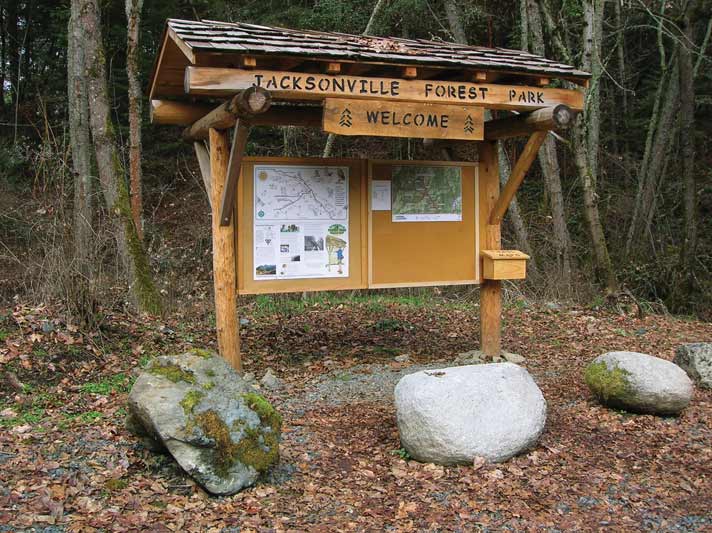
We can’t help but be thankful that we have these nearby woodlands to venture into so easily. Whether walking from town into the Jacksonville Woodlands surrounding us or venturing a bit further into Jacksonville’s Forest Park in the Jackson Creek Watershed, our citizens have a resource of which few other cities can boast. Our Public Works Department and their dedicated volunteers work year-round to make these areas desirable to visit. Currently, after last winter’s heavier rains and runoff, modifications to some Forest Park trails are underway to counteract some heavy erosion. Trails should remain open but be aware that there may be some route adjustments.
 Trail Talk is a monthly column by Clayton Gillette about hiking the Jacksonville Woodlands trail system. For more information, please visit the Jacksonville Woodlands Association website at