
The Unfettered Critic – July 2025
THE PANDAMMIT OF 2020 changed the world of entertainment. It was a tedious period, during which we stopped visiting Places and Events that we’d long relished: Restaurants. Movie theaters. Music festivals. Backyard barbecues. Family gatherings. And, of course:
OSF: The renowned Oregon Shakespeare Festival located a mere half-gallon of gasoline down (Or is it up?) the road in Ashland. It stands as a world-class venue of live theatrical performances. World-class, yes, but dammit, the Pandammit was world-class too.
Since the crisis has decreased, your eclectic duo has visited the location several times. Once just to walk about on its hallowed grounds to mourn the loss of the lovely gift shop (since restored to its previous glory and more!).
Happily, the recent arrival of visitors from out-of-town (yes, camaraderie is back!) reminded us that OSF is a great place to show off. We could have impressed our friends with a Bard play in the magnificent Allen Elizabethan theater, but concerned that it’s a bit early in the season to predict the meteorological climate for a lengthy outdoor sit, we chose a production at the always comfy, indoor Angus Bowmer Theatre.
And what production did we choose? Oscar Wilde’s fabulously farcical The Importance of being Earnest, because we hoped it would be, well, fabulously farcical.
A “farce,” as you likely know, is a comedy in which everything—everything—is absolutely absurd. Expect slapstick, deception, miscommunication. Author Wilde excelled at the genre. When he wrote Earnest in 1895, he was poking at the very heart of the stodgy Victorian society he lived in. That’s perfect for OSF, which is equally renowned for another thing: shifting classic material into different periods, genders, locations, and whatever other creative transitions may surprise us.
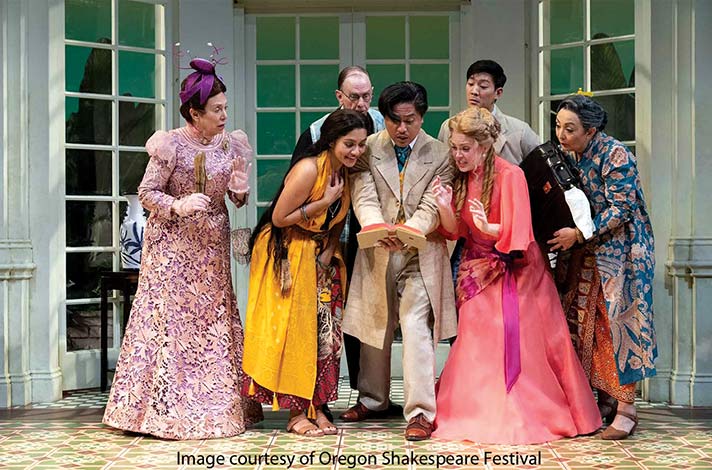
In this case, director Desdemona Chiang, who was born in Taiwan, was familiar with the material, but held no fond memories of this comedy of manners. Her initial encounter with Earnest was in a college acting class, where she played one of the very proper tea-sipping British characters. She admits that attempting a convincing Brit accent was a bit traumatic, so this year, when challenged to direct Wilde’s best-known play, she fashioned a way to make it innovative for both herself and the audience.
The British Empire, the director recalled, was quite expansive in Victorian times, with settlements all over the world, including the British Malay Peninsula. And that is where Chiang chose to set the work.
And work it does—like the seasonings in an exquisite quasi-national dish—as the cast and creative team blend their own variety of exotic flavors. Performers Thilini Dissanayake as sweet Cecily, Hao Feng as the humorously preening and scenery-chomping Algernon Moncrieff, and Julian Remulla as John Worthing, the man who was abandoned as an infant inside a handbag at Victoria Station. And speaking of seasoned, Linda Alper, a veteran of over fifty productions at OSF, appears in the key role of shrill Lady Bracknell, a performance well worth even an entire gallon of gas.
For those of you who didn’t read the play in college, the plotline seeks an answer to the question: Which of the characters using the name Ernest actually is named Ernest; who is the most earnest in using the name Ernest; and why is the name Ernest important in the first place?
Wilde keeps this quandary going for the two-hour-plus running time. Should you go see it? When asked to comment on his play, the author said, simply, “It is exquisitely trivial.”
How could you possibly resist responding to a review like that, especially since it’s right down (up?) the road?
 Paula and Terry identify as writers, with an ever-increasing number of published works to support the supposition. They live a primarily pastoral life in the enchanted town of Jacksonville.