
On Real Estate & More – March 2025
SENATE BILL 762 made extensive changes to the Oregon wildfire policy, affecting how the state responds to wildfires and potentially requiring property owners make modifications to their property in order to lower their wildfire risk.
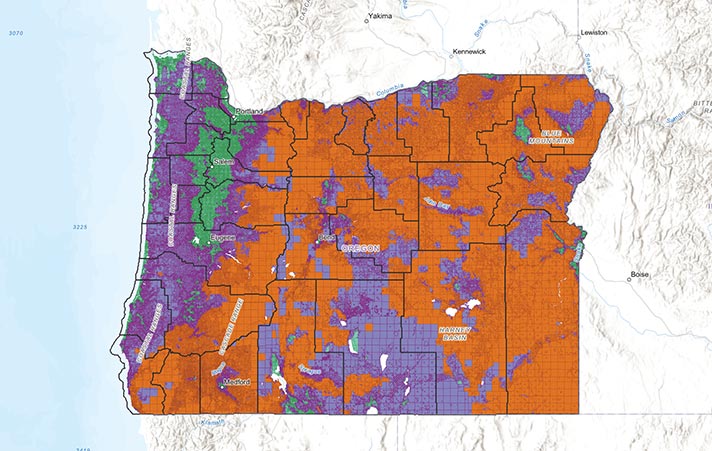
In 2022, in response to Senate Bill 762, the Oregon Department of Forestry (ODF) sent out a Draft Oregon Wildfire Risk and wildland-urban interface maps to the public that was created by ODF and Oregon State University (OSU). The maps showed the wildfire risk of approximately two million tax lots across the state. The maps drew intense criticism and therefore just five weeks after publishing the map, ODF announced they were withdrawing the map.
Since that time, the maps were redeveloped, and final versions were released in January 2025. Scientists used data from wildfire hazard models to assign a hazard classification to every property in Oregon. Each lot was then assigned to one of three hazard zones: low, moderate or high.
The wildland-urban interface (WUI) is the geographic area where structures and other human development meet or intermingle with forests, rangelands and other vegetation.
The statewide hazard map and the WUI map are designed to be used together to help state agencies prioritize the communities with the highest need for hazard mitigation. To do that, agencies will use both maps to identify properties that are in the WUI and classified as high hazard.
Only properties meeting both criteria are potentially subject to defensible space and fire hardening rules. Fire hardening rules will not apply to existing structures unless significant home updates occur. The codes for both defensible space and fire hardening are currently in draft form and are not adopted for enforcement.
What this means for you:
Owners whose property was identified as being within both a high hazard zone and the wildland-urban interface were mailed a packet that explained the new codes and how they may be impacted.
Home Hardening: If you are in a high hazard and in the wildland urban interface:
- Building code standards are not retroactive. They apply only if you replace a covered item (for example, roof or siding) or add onto your home.
- If you replace a covered item, or if you are adding onto your home, you need to use home hardening materials once the code is adopted.
- You do not have to change materials for partial repairs that do not replace the entire item.
Home hardening examples:
- Roofing: Make a roof more fire-resistant by installing Class A or B roof coverings
- Exterior wall covering: Install noncombustible or ignition-resistant siding and trim.
- Ventilation: Install ember- and flame-resistant vents or 1/8-inch wire mesh.
- Soffits and eaves: Enclose soffits and eaves with noncombustible or ignition-resistant materials.
- Windows and skylights: Install tempered, multi-layered, or fire-resistant rated glass.
- Walking surfaces: Enclose the underside of decks, porches, and balconies and construct them with noncombustible, ignition-resistant, or fire-retardant-treated materials.
- Gutters: Install noncombustible gutters and guards or covers to prevent leaf and debris build-up.
- Manufactured home skirting: Install noncombustible or ignition-resistant skirting to enclose the space under the home.
For more information about home hardening, go to the Oregon Building Codes Division at bcd.firehardening@dcbs.oregon.gov or at Oregon.gov/bcd and click on “Wildfire Hazard Mitigation” under “Current topics.”
Defensible Space: Defensible space is the protective area you create around a home or building by maintaining the grass, trees, shrubs, and vegetation that surrounds it. Proper defensible space can slow or stop wildfire spread and increase your home’s chance of survival in the event of a wildfire. If you are in a high hazard and in the wildland urban interface:
- In the future, your property may be subject to the standards in the Oregon Defensible Space Code. The code is under development.
Defensible Space Recommendations:
- Clear out dried leaves and pine needles from gutters, eaves, and around your chimney.
- Trim the lower branches of trees so they don’t act as a ladder for fire to reach the treetops.
- Keep patios free of dry materials, like leaves or old wood, especially in the summer.
- Store firewood and leftover construction materials at least 30 feet away from your house.
- Trim bushes near your house so they don’t touch the walls or siding.
- Clean leaves, needles, and debris off your roof and out of gutters regularly.
- Remove plants and bushes growing directly under the eaves of your house; leave at least a five-foot gap.
- Use 1/8-inch metal mesh to cover attic vents, soffit vents, and open spaces under decks and patios.
- Clear leaves, dead wood, mulch, and other debris from on, under, and around decks and fences.
You can request a free, education-only assessment with a fire service member to get recommendations for your property. Request an assessment through oregondefensiblespace.org.
 Sandy J. Brown lives in Jacksonville and is a real estate broker and land use planner with Windermere Van Vleet Jacksonville. She can be reached at sandyjbrown@windermere.com or 831-588-8204.